


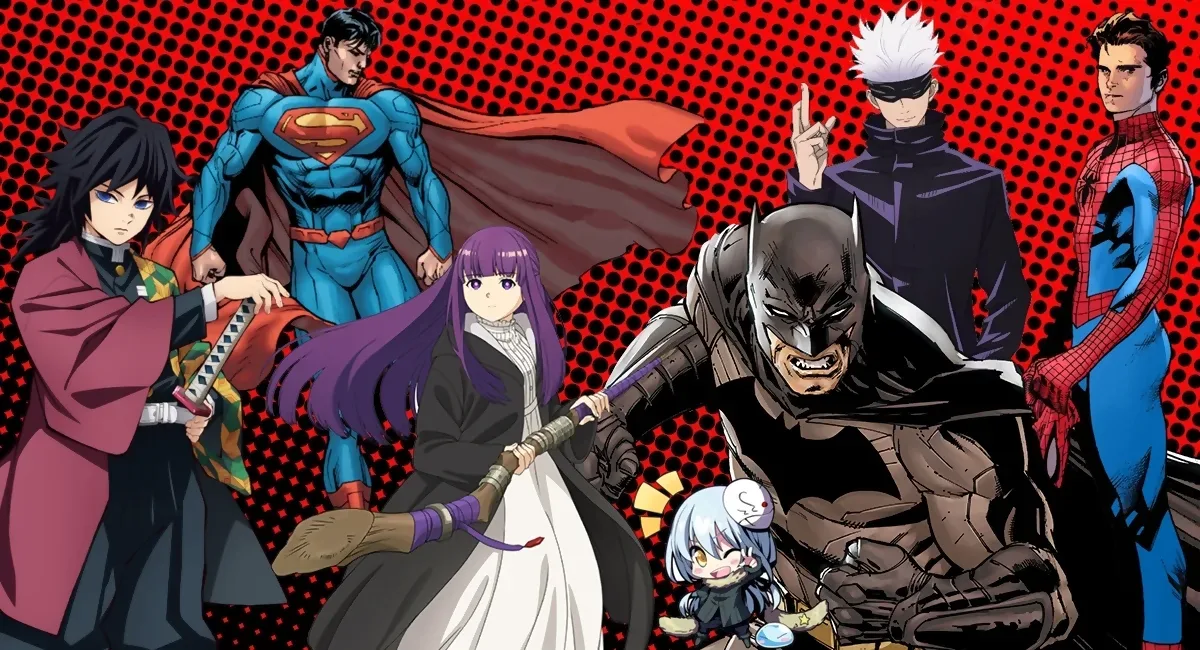
The audacity of the manga industry stands out in relation to that of comic books, since when a hero succumbed or a plot reached its conclusion, it was truly the end.
Marvel and DC Comics are always in a cycle of recycling characters Man adventure, alternate universes, new magazine imprints, but never completely finishing a character's arc.
This approach isn't a problem in itself. Iconic stories are born this way, and these characters become enshrined as legends in pop culture. However, this approach also leaves the characters in a boring cycle. How many times has Clark Kent learned to fly, and how many times has Peter Parker developed artificial webbing? Besides the eternal suffering they endure to "develop the character," overcoming traumas and personal problems, with events that are increasingly dramatic compared to the character's last appearance.
The biggest problem with this recycling of stories is the lack/restriction of creativity for new projects. Few publishers are able to invest in new ideas, and even fewer are able to publish independently.
The comic book market is only used to Marvel and DC. There's not much incentive for new authors, because the public won't buy those stories.
But what about manga?
The Japanese industry has never experienced this problem because manga are extremely personal works, usually created by one or two people, although there are exceptions, such as CLAMP .
When a comic book is produced by a major publisher, it needs to be a success, period. If the story doesn't fit the industry standard, it will be rewritten. The author and illustrator work for the publisher; it's their job to create a product that meets market demands. They can't reject the publisher's suggestions and say, "My story isn't like that!" or "But my art style doesn't follow that style.".
In this respect, does Japanese manga have more freedom, much more freedom? No, but at least it can choose its captor (publisher).
The manga artist presents an idea to the publisher, and this idea will be developed together with an editor, who will ensure that the idea aligns with the publisher's goals and is profitable. The manga is the intellectual property of both the author and the publisher, which is why we sometimes see the author participating in the production of the manga's anime adaptation; as the creator, they have a say in what happens to their work.
Batman comic book writer and Bane co-creator Charles “Chuck” Dixon discussed manga on his podcast Ask Chuck Dixon #65 on YouTube, answering the question:
What's your theory/thought on why manga is wiping the floor with American comics?
"It's not very difficult to figure out, actually. There's a lot of dedication, passion, and skill in manga. And that's almost entirely lacking at Marvel and DC."
Dixon also praises the art of manga. “It’s not hard to see. The art is appealing. It’s different, engaging, interesting, varied. Therefore, there are many reasons to like manga.”
One of the most curious things about manga is the variety of different themes that the stories address, with diverse options for each niche. There's a series of manga about reincarnating in another world, and sub-niches about reincarnating in another world and doing something very specific (no need for examples). In this regard, Chuck comments on the lack of variety in comics and how manga explores all kinds of stories, embracing any type of reader.
"In Japanese manga, there are stories about golf. There isn't just one story about golf. There are many comics about golf."

He then talks about the stark contrast with the American market: “But here, what do we get? We get superheroes and poorly made superheroes. There’s really nothing else in the big companies. […] And they’re all avatars of the writers’ political agenda. And they’re kind of tiresome. They’re not particularly well-designed. They’re not particularly well-executed.”
Chuck explains that the American market should learn from manga: “And I don’t mean drawing people with huge eyes and lots of fast-paced lines. I mean, make more varied stories. Make more complex stories. Put more effort into the art. Put more effort into the craft. Change the format, for God’s sake. Stop making comics in folio format and see what manga does. Those big, thick phone books. Comics released weekly. Things like that. Just change the formula. See what manga is doing. Why is manga successful? Try to copy that.”
The decline of comic books has several causes, including the artificiality of the stories, recycling of characters, lack of creativity and novelty, the format of short monthly magazines, etc. In addition, there's the overexposure following the popularization of superhero movies, which likely holds back a large part of the industry.
What happens with smaller-scale manga adaptations, where instead of replacing the manga, they attract an audience? Could a superhero movie have the same effect? That's the question.
Finally, I'd like to clarify that I love comic books, and this text is in no way a critique of the medium itself, but rather of the American industry and the major publishers.
Follow AnimeNew on Instagram !