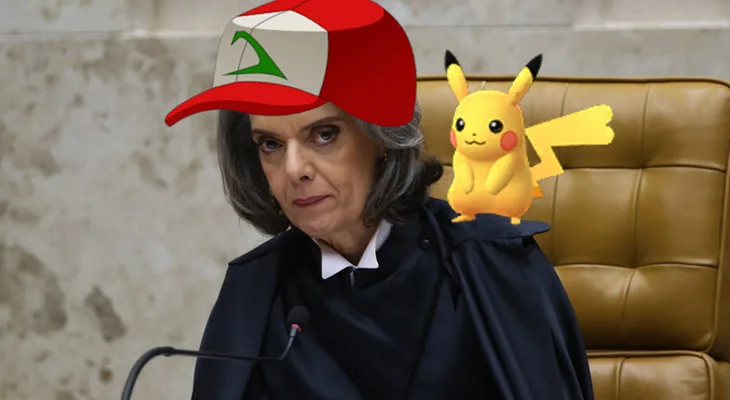
Denying a request from the Attorney General's Office (AGU) of President Jair Bolsonaro 's government (without party affiliation), the Supreme Federal Court (STF) ruled that the Pokémon TCG card game is exempt from taxes in Brazil. Check out the ruling .
Minister Cármen Lúcia accepted the argument that the letters encourage reading and therefore can be considered books for tax exemption purposes. Currently, a basic package of 20 letters costs R$15.00.

Therefore, the tax benefit is provided for in Article 150 of the Federal Constitution, which provides for tax exemption with the aim of reducing the final price of books, newspapers, and sticker albums. The law was created to reduce the final price of items that can stimulate public access to culture, information, and education.
Although a Pokémon card is not a book or even a sticker, Minister Cármen Lúcia agreed that the law needs to be interpreted broadly and that the cards can indeed encourage children to become familiar with printed media. "Ultimately fulfilling the purpose of the tax benefit," the minister assented.
The decision was published in April of last year and could pave the way for other card games to be exempt from taxes, like books in the country.
Recently, the Minister of Economy, Paulo Guedes, floated the possibility of ending the tax exemption for books (via Gazeta do Povo). If he goes ahead with the idea, the federal government will be able to tax Pokémon cards.
FEDERAL GOVERNMENT VS. POKÉMON CARDS
The dispute over Pokémon anime cards and Brazilian tax legislation is not recent. The currency was launched more than a decade ago, in 2009
On one side, the Center of Industry of the State of Amazonas (Cieam) and the Attorney General's Office of the National Treasury (PGFN), an agency linked to the Union (AGU), were challenging in court the tax benefit granted to the company Devir Livraria in the sale of Pokémon TCG.
Devir framed the game as an educational object and therefore benefited from the tax exemption for books and newspapers. After analyzing the issue for years, the Federal Regional Court of the 3rd Region (TRF3) ruled in favor of Pokémon and denied the application of the additional taxes requested by the federative entities.
But the federal government still held some golden cards in this dispute.
In 2020, the Attorney General's Office for the National Treasury, as if using a coach's letter, took the discussion to the Supreme Federal Court (STF), the highest court in the country. The PGFN filed an Extraordinary Appeal with Aggravation (ARE), asking the STF to suspend the decision of the Regional Federal Court of the 3rd Region (TRF3) and allow the application of taxes until the matter was decided once and for all.
That's when the unusual happened. The definition of what Pokémon cards are and the government's request ended up on Minister Carmém Lúcia, who had to delve into the game.
The federal government argued that the TRF of equating Pokémon to books or a sticker album for tax exemption purposes was superficial. First, the TCG was a strategy. Second, and more obviously, Pokémon cards were not adhesive and therefore could not be considered stickers.
"The immunity rule provided for in the constitutional text aims to encourage the advancement of culture, democracy, education, and access to information, and a Pokémon game certainly does not serve that purpose"argued the federal government.
The PGFN (Brazilian Federal Attorney General's Office) was convinced that the cards did not encourage reading—they merely complemented a game of conquest and exchange, an element taxed by the Federal Revenue Service under the classification of "playing cards."
The Supreme Court did not accept the arguments. The fact that the Pokémon TCG game has interactive content and characters taken from manga, described by the defense as "illustrated books,".
The understanding went further. The Supreme Court Justice accepted that the Pokémon TCG encourages the pursuit of knowledge and framed a letter as a printed vehicle for transmitting information to a children's audience.
Furthermore, the arguments on the table include the inclusion of books and periodicals under the tax exemption rule.
Finally, the Supreme Federal Court (STF) denied the appeal and also ordered the federal government to pay 10% of the legal fees. The case returned to the Regional Federal Court of the 3rd Region (TRF3), where it can still be reviewed, but now with a very effective blow coming from a higher court.
Text copied from the blog: The Enemy